Where Capital City Roofing Operates Today.
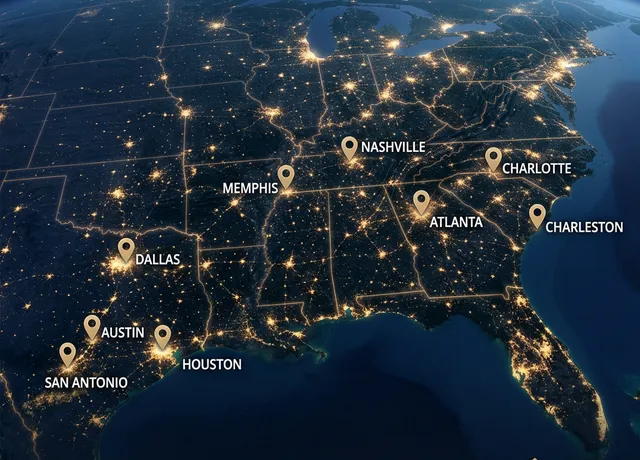
Atlanta is CCR HQ. Nashville and Charleston are active CCR licensees running the same playbook (BuilderLync + Sierra AI + the CCR Production Standard) in their markets. Three more states (Florida, Texas, North Carolina) are open for qualified operator applications. CCR does not mass-license. Markets are vetted on storm profile, population, operator capacity, and compliance readiness so the brand and the network are protected.
Markets outside this list are reviewed case-by-case during Discovery if an operator demonstrates strong fit and CCR ops bandwidth supports the launch.
Six States. One HQ. Two Licensee Flagships. Three Open.
Each card lists population, storm profile, contractor licensing notes, and current availability status. Click any state for the deep market page with operator-readiness questions and local fit signals.
Georgia
CCR Headquarters. Active flagship operator.
Metro Coverage: Metro Atlanta + Athens + Augusta
Population: ~10.9M statewide, ~6.3M Metro Atlanta
Storm Profile: Hail belt (March to July) + occasional hurricane remnants
Licensing: No state contractor license; municipal permitting per jurisdiction.
CCR Atlanta runs from Alpharetta. New Georgia operators are vetted carefully to protect the flagship market.
- •Largest CCR ops presence; fastest support response in the network
- •Manufacturer pathway support runs through Atlanta
- •Operator cohort culture established; weekly Atlanta meetups
- •Storm + retail balanced market; insurance and cash both viable
Florida
Hurricane + retail dual-mode opportunity.
Metro Coverage: Tampa + Orlando + Jacksonville + South Florida
Population: ~22.2M statewide; 4 metros over 1M
Storm Profile: Hurricane season (June to November) + year-round retail demand
Licensing: State Certified Roofing Contractor license required (CCC).
- •Year-round work due to climate; not a seasonal market
- •CCR ops familiar with Florida CCC licensing pathways
- •Insurance market sophisticated; supplements are higher-stakes
- •Strong existing GAF + CertainTeed contractor density
Texas
Largest hail-corridor opportunity in the network.
Metro Coverage: Dallas-Fort Worth + Houston + Austin + San Antonio
Population: ~30.5M statewide; 4 metros over 2M
Storm Profile: Tornado alley + DFW hail capital of the US
Licensing: No state roofing contractor license; municipal requirements apply.
- •DFW historically the highest hail-claim market in the US
- •Insurance supplement workflow critical; CCR partner support included
- •Population growth still positive; new construction roof retrofits ongoing
- •No state contractor license simplifies operator activation
North Carolina
Coastal hurricanes + Piedmont retail growth.
Metro Coverage: Charlotte + Raleigh-Durham + Greensboro + Wilmington
Population: ~10.8M statewide; multiple metros 500K+
Storm Profile: Coastal hurricane exposure + occasional Piedmont hail
Licensing: NC General Contractor license required at certain project value thresholds.
- •Diverse market: coastal storm dynamics + Piedmont retail demand
- •Population growth strong, especially Charlotte + Raleigh metros
- •Operator licensing pathway varies by county; CCR ops advises
- •Adjacent to CCR Atlanta network for support and benchmarking
Tennessee
Active CCR licensee in Nashville.
Metro Coverage: Nashville + Knoxville + Chattanooga + Memphis
Population: ~7.1M statewide; Nashville metro ~2.0M
Storm Profile: Severe weather + tornado season (March to May)
Licensing: TN Contractor license required for projects $25K+ residential.
CCR Nashville is an active licensed operator running the playbook in Music City. New Tennessee operators are vetted to protect that market and the existing licensee.
- •Active CCR licensee operating in Nashville: real licensee proof point
- •Storm + retail balanced; insurance market less saturated than DFW
- •Strong music + entertainment-tied retail demand
- •Adjacent to CCR Atlanta network for cross-market support
South Carolina
Active CCR licensee in Charleston.
Metro Coverage: Charleston + Columbia + Greenville
Population: ~5.4M statewide
Storm Profile: Coastal hurricane exposure + inland severe weather
Licensing: SC residential builder license + roofing classification required.
CCR Charleston is an active licensed operator running the playbook on the South Carolina coast. New SC operators are vetted to protect that market and the existing licensee.
- •Active CCR licensee operating in Charleston: real licensee proof point
- •Coastal storm exposure creates supplemental insurance work
- •Charleston is one of the strongest retail roofing markets in the Southeast
- •Adjacent to CCR Atlanta network for cross-market support
Six Inputs. Disciplined Output.
CCR does not mass-license to fill a sales quota. Each market activation is sized against operator capacity, storm and retail balance, compliance complexity, and existing CCR network proximity. The discipline is what keeps unit economics strong.
Population + housing stock
Metro size, single-family roofing inventory, and roof-age distribution
Storm activity
Hail frequency, hurricane corridor exposure, and insurance claim volume
Operator capacity
CCR ops bandwidth and the operator pipeline already in motion for the market
Compliance readiness
State contractor licensing requirements, insurance requirements, and permit complexity
Existing operator proximity
Distance from other CCR operators and any preferred-market overlap risk
Market growth trajectory
Population trend, new construction velocity, and projected roofing demand
Preferred Market, Not Legal Exclusivity
CCR designates preferred markets so operators can plan launch and scaling without surprise overlap. We do not grant exclusive territories in the legal sense; instead, we hold ourselves to a discipline: do not over-license a market in ways that harm operator unit economics. The discipline has held since the first Atlanta operator went live.
Specific market designation language and any market-specific supplemental programs (storm vs retail) are documented in the partner agreement and reviewed during Territory Review at the end of the application process.
Ask About Your Specific Market
The Operator Audit captures market interest in the first question. Discovery Call is the right place for territory specifics, capacity discussion, and any state-specific licensing planning. Markets outside the active six are reviewed case-by-case if operator fit is strong.
